Chaplain Shelby Smith served at a local church for 19 years before joining Arkansas Heart Hospital. Here, he has the opportunity to meet the spiritual needs of patients, their families and our staff. In addition to offering prayer and encouragement, Chaplain Shelby Smith shares a weekly devotional. 
Have you noticed people seem to be more easily offended these days? Such as restaurant customers offended for having to wait for service, or the worker who is offended because he was asked to work extra hours. What about the person who is angry at the police officer for pulling him over for speeding? Or anger toward politicians for supporting something others disagree with? 

People can be especially offended if you express a viewpoint different than theirs. It seems recently even during a short conversation with someone, you will hear about something that offends or makes them angry. 

I recently listened to a sermon by Craig Groeschel, the pastor of Life Church in Oklahoma, where he spoke on, “Being Offended and Anger.” Here is a portion of that sermon: 

“Is your anger making you more like Jesus? Is it making you more joyful? Is it pointing others to the intimacy and life and freedom and joy of Christ? Is it making you more loving? Is it drawing others into a more joyful life? 

We find written in James 1:19, “Everyone should be quick to listen, slow to speak and slow to become angry because human anger does not produce the righteousness that God desires.” 

Whether our anger is at some small offense or at a major betrayal, an opposing political view or at someone who cut you off in traffic, human anger does not produce the righteousness that God wants.  

Now you might argue that your anger is righteous anger — anger over sin or anger at things that break God’s heart. You may have that kind of anger, but have you noticed most of the time when we have righteous anger it is about someone else’s sin? It may not be a righteous anger after all, but self-righteous anger.  

As a Christ follower, it may be easy for me to criticize someone else’s foul language and ignore my own spiritual pride and gossip; easy for me to judge someone else’s sexual sin and ignore my gluttony and selfishness. We all tend to think our anger is justified. 

Ask yourself these questions:  

  • Are people drawn to the grace and goodness of God because of my anger?  
  • Is my anger bringing me more joy?  
  • Is it blessing and enhancing my marriage?  
  • Is it giving my children a life they want to emulate?  
  • Is my anger a blessing to others or criticizing others? 
  • If we claim to be followers of Christ, we will eventually have to make a decision. We will need to decide when we get angry. 

Do we want to make a point, or do we want to make a difference? Too many people simply want to make a point; they want to win the argument.  

If we want to make a difference, then we will need a different attitude and a different philosophy in dealing with the wrongs of the world. Rather than letting our flesh, feelings and emotions direct our actions, we need to allow the spirit of God to direct our actions. That way we are not just making a point, not just trying to win an argument, but trying to win people to the grace and goodness of Jesus. There is a big difference. 

Matthew 22:35-39 tells the story of a smart guy, an expert in Jewish law, who was in a conversation with Jesus. He asked Jesus a question, “What is the most important thing?” Jesus replied, “Love the lord your God with all your heart and with all your soul and with all your mind. This is the first and greatest commandment. And the second is just as important, love your neighbor as yourself.” 

Jesus is telling us that we are to love God with everything in us. Every fiber of our being should worship and glorify Him in everything we do. And the way we love Him is by loving his people and showing them grace and having empathy and compassion for people. 

You might be asking, “Practically, how do I deal with being easily offended and my anger?” 

I believe there are a couple of practical things you can do. Lower expectations of others; people are not perfect, and neither are you. Raise your gratitude for God’s grace; He forgave us when we didn’t deserve forgiveness. 

In John chapter 8, there is a story of a woman caught in the act of adultery. The group of men who brought her before Jesus said the law commanded them to stone her to death. They all had their pockets filled with stones prepared to carry out her sentence.  

Then, they asked Jesus what he thought. It is written that Jesus bent down and began to write on the ground with his finger. As they questioned him again, Jesus said, “Let anyone of you who has not sinned throw the first stone.”  

Slowly, they began to drop their stones and walk away one at a time until there were no accusers left. Apparently, they realized they also did not measure up and decided they too wanted grace. 

Let me ask you: What’s in your pocket? Is it filled with stones or is it filled with grace? 

Jesus commanded us to be quick to listen, slow to speak and slow to become angry. If we applied this verse to our daily lives, we might all be less offended and less angry. 


Sushi doesn’t need to be off limits after bariatric surgery. Our Bariatric and Metabolic Institute (BMI) dieticians share a low-carb sushi hack, so you can enjoy sushi after weight loss surgery.

Made with salmon, riced cauliflower, avocado and cucumber, these sushi bites pack a punch of protein and healthy fats minus the carbs. It’s a win-win.  

Grab your apron, roll up your sleeves and try making these BMI-friendly sushi bites.  

Ingredients:  

  • 1 fresh salmon filet (roughly 3 pounds)  
  • 3 tablespoons of softened salted butter 
  • ¾ cup tablespoons of Duke’s mayo, divided use  
  • ¼ cup minced garlic  
  • 1 16-oz package riced cauliflower  
  • ¼ cup rice wine vinegar  
  • Splenda 
  • Sriracha 
  • 2 packages of seaweed snacks (Simple Truth Wasabi Roasted seaweed snack from Kroger is preferred)  
  • 1 medium English cucumber sliced into strips  
  • 1 sliced avocado 
  • Reduced sodium soy sauce 
  • Everything but the Bagel seasoning to taste 

Directions:  

  1. Preheat oven to 350 degrees.  
  2. Line a baking sheet with foil and place the salmon filet skin side down on the foil. 
  3. Combine softened butter and 6 tablespoons of mayo and garlic, then spread on top of the salmon filet.  
  4. Bake 40 minutes or until the thickest part of salmon registers 160 degrees on meat a thermometer. Allow it to cool.  
  5. Crumble half of the filet into a bowl and add 6 tablespoons of Duke’s mayo and sriracha to taste (the more sriracha, the spicier it is!) Stir to combine. Reserve the other half of salmon for another use such as salmon croquettes. 
  6. In the microwave, cook riced cauliflower in its package on high for 4 ½ minutes. Empty the bag into a bowl and sprinkle rice wine vinegar on top of rice. Add about ¼ cup Splenda and stir until combined.  

To Assemble:
Place seaweed snacks on a plate and top with a spoonful of cauliflower rice, 1-2 tablespoons of the salmon mixture, 1-2 slices of cucumber, 1 slice of avocado and Everything but the Bagel seasoning to taste. Drizzle it with low sodium soy sauce. 

The nutrition information will vary based on how much salmon mixture is placed on each sushi bite. 

Enjoy and don’t be afraid to branch out with different combinations like shrimp or crab! 


Check more BMI-friendly recipes on our blog for more great foods after weight loss surgery. You can also see our weight loss surgery success stories!

Ready to start your weight loss journey? Learn more here. 

Chaplain Smith / Debbie McDaniel

What does the Thanksgiving holiday reveal to you about yourself? Do you live a life of thankfulness? Or is it and emotion or mindset you dust off each year around this time?

Writer Debbie McDaniel said, “I believe that thankfulness is a barometer of our level of Faith. I believe that thanksgiving or the giving of thanks is the expression of Faith. In fact, it may be the highest expression of Faith.”

I tend to agree with her statement. During my years as a missionary, I visited countries where people were living on a tiny fraction of the income of the poorest family in this country. They were hard-working, hopeful and faithful. That faith manifested itself through thankfulness and joy, which was not rooted in their present circumstances but in their Faith in God and a knowledge that He recognized their plight. It was as if they trusted that even if God did not change their circumstances here, they were still better off believing. They believed His word in Psalm 68:19, “Praise be to the Lord, to God our Savior, who daily bears our burdens.” Another translation reads, “Praise be to the Lord who daily loads us with benefits.” They had an understanding that not all of God’s benefits were in the form of financial gain or relief.

Unfortunately, I don’t always notice that widespread thankfulness here in what I would term the “Land of Plenty.” Now I know there are people who are poor and struggling and are having a difficult time making ends meet here in our country. There are people that come to us daily that are facing life-changing decisions concerning their health. There are those on our staff that are struggling with marriage issues, loss of a spouse or a child, the repercussions of past or present mistakes and some even facing a financial meltdown. If one of these conditions describes your plight, how are you facing it? With Faith expressed in thankfulness or complaining, blaming and ungratefulness? Remember those in the third world countries are facing those same problems with far fewer resources to rectify those issues. But with an amazing display of Faith, they find ways to be thankful.

Psalm 107:1 reads, “Give thanks to the Lord, for He is good and his love endures forever.” Sometimes it is really a sacrifice to offer praise and thanks. There are times when we may not feel like it. We’re struggling. We’re weary. Or maybe, we feel like God has let us down.

Let me ask you, do you measure God’s blessings by the barometer of health, wealth and happiness only? Do you measure God’s faithfulness to you by what someone else has? If so, be careful. In looking at life that way, you can always find someone who is doing better. If you are not careful, a spirit of ungratefulness can sneak in, and you become filled with bitterness, fear, negativity, selfishness and self-pity. These are some of the Devil’s favorite tools for taking you down.

This season is not always happy for everyone. For some this season serves only as a reminder of what they have lost, and it is difficult to get through the loneliness and pain. We must face those difficulties with the knowledge that God is still good even when he does not give us what we want. You might also get through this season by reaching out to someone who is really struggling and ask God to use you to encourage them.

I have found that, getting up each day and thanking God for the little things gets me off to a good start. I thank him for my wife, my children, my family, saneness(though some may question this), the sunny day or the rainy day. Simple things that for the most part are not owned or directed by me. I try to name at least five or six little things each morning that I am thankful for and throughout the day I try to add to the list. We have a choice, every day, to give Him thanks.

With a heart of thanksgiving, we realize that no matter what we face, God doesn’t just work to change our situations and help us through our problems. He does more. He changes our hearts. His power, through hearts of gratitude and focused minds on Him, releases the grip our struggles have over us. This allows us to live thankfully. If nothing else, Thanksgiving reminds me to be thankful for the things that money cannot buy which keeps me from being controlled by the things that money can buy. 1 Thessalonians 5:16-18 instructs us to “Rejoice always, pray continually, give thanks in all circumstances for this is Gods will for you in Christ.”

So, my friends, BE THANKFUL! HAPPY THANKSGIVING! LET’S PRAY!

Posted in All

The Arkansas Heart Hospital Bariatric & Metabolic Institute (BMI) cooks up a delicious BMI-friendly Thanksgiving feast. Dishes include roasted cornish hens with herbed gravy, southern dressing, cheesy broccoli “rice” casserole, cranberry sauce, rolls and pumpkin spoonbread. Watch the BMI team cook live from the kitchen below, and find a shopping list, ingredients, instructions and nutrition information.

Menu: 

Roasted Cornish Hens with Herbed Gravy
Southern Dressing 
Cheesy Broccoli “Rice” Casserole
Cranberry Sauce 
Rolls 
Pumpkin Spoonbread 

Shopping List: 

Produce:  

  • Celery (1 bunch) 
  • White onions (1 bag) 
  • Cranberries (1 bag) 
  • Orange (1) 
  • Lemon (1) 
  • Riced cauliflower (1 16-oz bag; do not freeze) 
  • Broccoli florets (12-oz, frozen) 

Protein:  

  • Cornish hens (found in freezer section) 
  • Eggs 

Dairy:  

  • Butter (1 pound) 
  • Block cheese (32 oz) 
  • Light sour cream (24 oz) 

Misc. 

  • Kitchen string 
  • Keto Hawaiian rolls (Healthy Life brand) 
  • Zester 

Canned:  

  • Better than Bouillon roasted chicken 
  • Pumpkin (1 can; Libby’s brand) 
  • Low sodium chicken bone broth (1) 

Baking/Spices:  

  • Kosher salt 
  • Black pepper 
  • Ground sage 
  • Poultry seasoning 
  • Garlic powder 
  • Almond flour 
  • Coconut flour 
  • Splenda 
  • Nonstick cooking spray 
  • Zanthum gum 
  • Corn starch 
  • Baking powder 
  • Baking soda 
  • Cinnamon 
  • Pumpkin pie spice 
  • Canola oil 

Cornish Hens 

Ingredients:  

  • 2 Cornish hens (thawed) 
  • ¼ cup Basic Blend (equal parts salt, pepper, garlic powder)  
  • Spice blend of preference (Trader Joe’s 21 Seasoning Salute used)  
  • Thinly sliced lemon 

Instructions:
Pull thawed hens out of refrigerator 30 minutes before roasting. Preheat oven to 400?F. Loosen skin, season top of skin and under skin with basic blend. Liberally season with spice blend of choice. Place a couple of thin lemon slices in cavity, tie legs with kitchen twine. Roast at 400?F for 15 minutes, then reduce heat to 350?F and cook another 40 minutes basting with pan juices every 10 minutes. Hens are done when they reach 180?F in thigh. Allow to rest 10-15 minutes before carving  

Make ahead tips: 
Line baking pan with aluminum foil. Pat thawed hens with paper towels until dry. Place on paper towel lined baking sheet which will absorb any extra liquid. Cover with foil and refrigerate until ready to use.  

Nutrition per 3-oz serving:
Calories: 150
Carbohydrates: 0g
Fat: 10.5g
Protein: 14.5g 

Herbed Gravy  

Ingredients: 

  • 5 Tablespoons butter  
  • Basic blend (equal parts kosher salt, freshly ground black pepper, garlic powder)  
  • 2 teaspoons xanthan gum  
  • 1 ½ cup reduced sodium chicken bone broth  

Instructions: 
Melt butter in medium saucepan. Allow to begin browning (about 4-5 minutes, this may take longer depending on thickness of saucepan). Lower the heat and gradually add in xanthan gum, whisking constantly to prevent clumping. Continue whisking 3-4 minutes or until the butter starts to thicken. While whisking, add remaining ingredients. Continue whisking at least 5 minutes or until gravy has reached your desired consistency.  

Nutrition per 2 Tbsp (1oz) gravy: 
Calories: 45 
Carbohydrates: 0g net
Fat: 4.5g
Protein: 1g 

Southern Dressing 

Ingredients:  

  • 2 ½ cups almond flour  
  • 2 Tbsp ground sage 
  •  2 tsp poultry seasoning  
  • 2 tsp baking powder  
  • 1 tsp kosher salt  
  • 3 eggs  
  • 1 Tbsp butter  
  • 4 Tbsp melted butter  
  • ½ onion, finely chopped  
  • 2 stalks celery, finely chopped  
  • 1 ½ to 2 cups reduced sodium chicken bone broth  

Instructions: 
Preheat oven to 350?F. Spray 9×13 inch baking dish with cooking spray. Heat 1 tablespoon butter in skillet over medium heat. Add onions and celery, sauté 5 minutes. In a large bowl, whisk together the almond flour, sage, baking powder and salt. Whisk well to remove any lumps. Add the eggs and butter and whisk together until well combined. Fold in the onion and celery. Slowly add the broth and whisk until well combined. The mixture will be VERY thin and runny. Pour into prepared baking dish and place in oven. Bake for 35 minutes or until the top is browned and the center is not jiggly. Let cool 5 minutes before serving.  

Nutrition per serving (roughly 12 servings per dish):
Calories: 200
Carbohydrates: 2g net
Fat: 16g 
Protein: 7 

Cheesy Broccoli “Rice” Casserole 

Ingredients: 

  • 1.5 cups light sour cream  
  • 1 Tbsp Chicken Better than Bouillon  
  • 24 oz cheese of choice shredded (do not use pre-shredded)  
  • 1 16-oz package riced cauliflower (cooked according to package directions; use fresh, available in the produce section)  
  • 1 12-oz package frozen chopped broccoli (cooked according to package directions) 

Instructions: 
Put sour cream in 6-quart pot. Turn heat to medium, whisking sour cream to prevent scorching. Add Better than Bouillon and whisk to combine. Add 2 cups of the shredded cheese, whisk constantly until cheese is completely melted. Follow cooking directions on riced cauliflower & broccoli. Add to cheese mixture. Add an additional cup of cheese to mixture to thicken. May be baked at 350 for 20 minutes if desired or served immediately.  

Nutrition per serving (roughly 18 servings per dish): 
Calories: 200
Carbohydrates: 4g net
Fat: 15 

Cranberry Sauce: 

Ingredients: 

  •  ½ cup water  
  • 1 cup Splenda or equivalent (for sweeter sauce increase to 1.5 cups)  
  • ½ teaspoon cornstarch  
  • 3 cups fresh cranberries  
  • Pinch of salt  
  • Zest of one orange 

Instructions: 
In a medium saucepan, combine cornstarch, Splenda, and water over medium high heat, stirring until granules are dissolved. Add cranberries and orange zest and bring to a boil, stirring constantly. Reduce heat and simmer for 5 minutes or until cranberries begin to pop and mixture has thickened. Add a pinch of salt and stir until combined. Set aside to cool. Pour into bowl and refrigerate for 3 hours. If smooth cranberry sauce is desired, place it in blender or blend with immersion blender. Strain and refrigerate.  

Nutrition per 2 Tbsp (1oz) sauce: 
Calories: 20
Carbohydrates: 3g net
Fat: 0g
Protein: 0g 

Pumpkin Smush Bread (Spoonbread)  

Ingredients:  

  • 1 cup canola oil  
  • 2 cups Splenda  
  • 3 large eggs  
  • 2 tsp vanilla extract  
  • 2 cups solid pumpkin  
  • ¾ cup coconut flour  
  • 1 tsp salt  
  • 1 tsp baking soda  
  • 2 tsp baking powder  
  • 2 tsp cinnamon  
  • 2 tsp pumpkin pie spice  

Instructions: 
In a medium-sized bowl, combine the oil, Splenda, eggs, vanilla, and pumpkin and set aside. In a separate bowl, combine the flour, salt, baking soda, baking powder, cinnamon, and pumpkin pie spice. Add the wet ingredients to the dry ingredients and mix until combined. Do not overmix. Grease and flour a 6×9 pan baking dish. Pour the batter into the dish. Bake at 325?F for 45-50 minutes or until you can insert a toothpick into the center of the loaf, and it comes out clean. Allow to cool in pan for 10 minutes before transferring to wire rack to fully cool.  

Nutrition per serving (roughly 18 servings per dish): 
Calories: 150 
Carbohydrates: 2.2g net
Fat: 14g
Protein: 2g 

Chaplain Smith HeadshotChaplain Shelby Smith served at a local church for 19 years before joining Arkansas Heart Hospital. Here, he has the opportunity to meet the spiritual needs of patients, their families and our staff. In addition to offering prayer and encouragement, Chaplain Shelby Smith shares a weekly devotional. 

We’ve entered my favorite time of year – the festive holiday season. For the next two months, we will be in a frenzy of buying and eating, though not necessarily in that order.  

I was thinking about Thanksgiving and wondered how many of us ever really think about the word “Thanksgiving” and what it really means?  

It’s a compound word of “thanks” and “giving.” “Thanks” is an expression of kind or grateful thoughts, gratitude or appreciation. “Giving” is defined as freely transferring the possession of something to someone, or to hand over. It goes on to be defined as to freely devote, set aside or sacrifice for a purpose.  

Given the definitions of the individual words, examine for a moment your rituals, activities and thoughts of the past related to this holiday. During the Thanksgiving season, what is your focus? Is it on your desire to have a grand feast? What happens if one of your favorite dishes is not presented? How do you respond when the turkey is burned or undercooked? What is your reaction to the aunt or uncle or cousin who comes to the gathering uninvited, or the relative that wants to talk too much during the game? 

In all the preparations, gatherings and disappointments, we can sometimes lose sight of what this holiday can really become. Oh, I know the stories surrounding how Thanksgiving came about and the stories about the pilgrims, Indians and turkey. But, when you step back, what does Thanksgiving really mean to you? 

For the past couple of years, Thanksgiving has looked quite different for many of us. The pandemic has changed how we gather and what we do when we get together. Some have experienced loss of loved ones. Others have experienced gain as they look back and assess what is really important. Now for the introverts, it has been heaven, but for the extraverts and huggers, well, it has been…the other place.  

We read God’s word in 1 Thessalonians 5:16-18, “Rejoice always, pray continually, give thanks in all circumstances: for this is God’s will for you in Christ Jesus.” 

To look at that again, it said to give thanks in all circumstances. You may ask: “you mean be thankful for the burned turkey? No, be thankful you had a turkey to burn. “You mean be thankful even though I lost a loved one to COVID this year?” Yes, be thankful for the time you had with them and memories of them that you still have. You may have a child, mother or spouse that is suffering from cancer and not expected to live much longer. Are you to be thankful even in this? While you are not thankful they are ill, you can be thankful for the time you have with them; for how God will use you to provide comfort and care for them; and how He will reveal himself through your “thanks-giving.” 

Hard things in life happen to us all. During this season of Thanksgiving, I challenge you to think about what would be most important to you if this were your last Thanksgiving, or the last for someone you love. What would you do differently this season? You see, we never really know just how much time we have left. 

This season, will you be the expression of kind and grateful thoughts? Will people around you feel your gratitude and appreciation? Will you freely devote yourself to sacrificially giving while investing yourself in others? Or is your Thanksgiving more about getting everything just right… just about you and your wants? That’s not really thanksgiving. That sounds like “thanks-getting.” Hmmm…something to think about.  

May God be glorified through you this Thanksgiving season.   

Meet Kelly, a patient at the Arkansas Heart Hospital Bariatric and Metabolic Institute (BMI), who under went gastric bypass surgery with Dr. Fuller. 

“In my early 20s, I was diagnosed with Hypothyroidism after a 30-pound weight gain. From that moment on, my weight has been a struggle.  

After having two children, it became even harder to try to lose weight. I tried Atkins. I tried the HCG diet where I would give myself shots in my stomach every day and live on lettuce basically. You name it, I have tried it.  

With years of my weight yoyo-ing out of control, I just gave up. I didn’t deny my cravings. If I wanted it, I ate it. I didn’t worry about the consequences.  

By age 44, I was 266 pounds, living with high blood pressure, sleep apnea and severe gastric reflux.  

After having a scope seven times in a year, I was told that my reflux had done extensive damage to my esophagus. The acid from my reflux had also caused ulcers on my vocal cords which contributed to a sore throat 24/7 for months on end. And I could completely lose my voice forever. 

Making a Change

After my diagnosis, I decided I had to make a change. I met with Dr. J.D. Fuller, bariatric surgeon at the Arkansas Heart Hospital Bariatric and Metabolic Institute (BMI), to discuss having the gastric sleeve done.  

During my initial appointment, we discussed my reflux. It was at this moment I learned that gastric bypass can, in many cases, cure reflux 100 percent. Guess what — it did! My reflux was completely gone as soon as I woke up in recovery from my gastric bypass.  

Victories Beyond the Scale

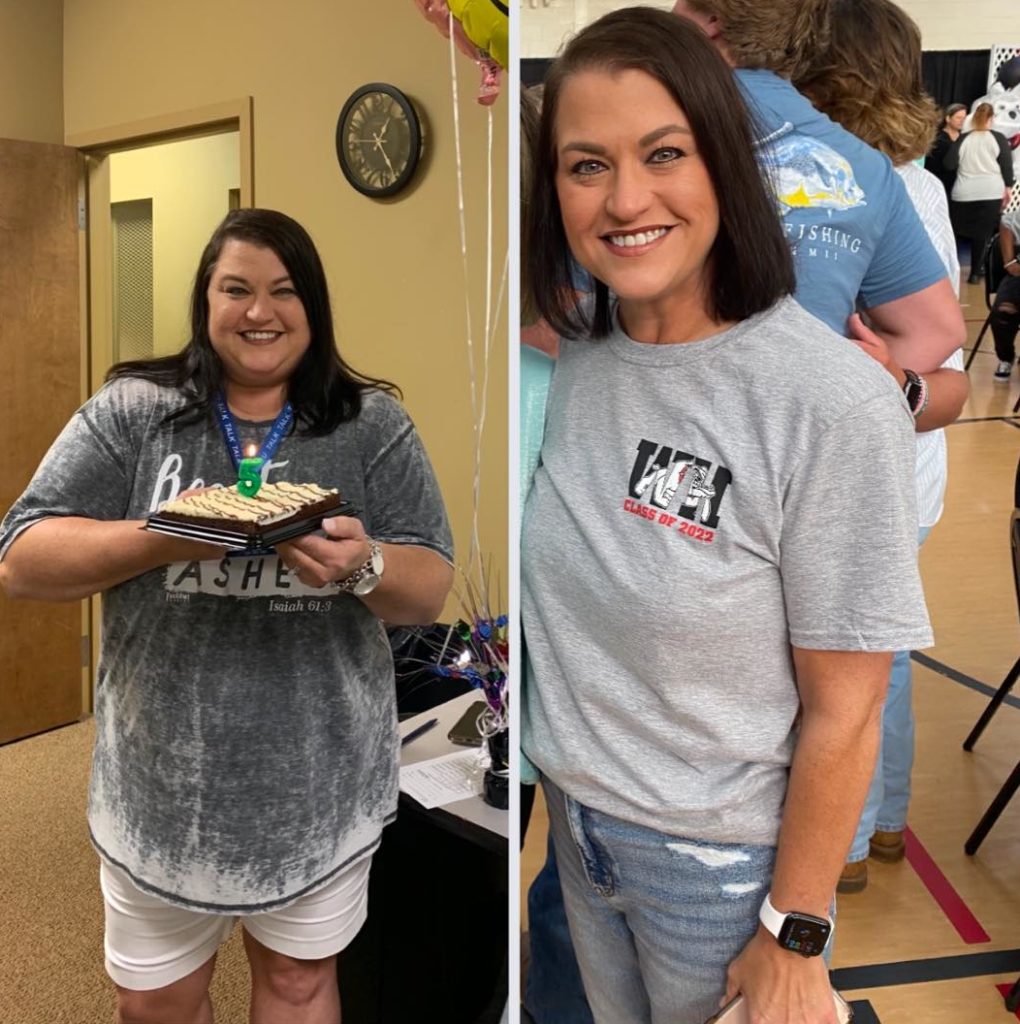
Ten months post-op gastric bypass, my health and my life have completely changed. My blood pressure is better than it has been in over ten years, I no longer snore like a truck driver, and my reflux has been eliminated. I have gone from size 18-20 to size 4. My current weight is 131 pounds.  

My husband Timothy and I work out almost daily, and we participated in a 15-mile bike race. Tons of energy would be an understatement. I feel better than I did in my 20s.  

If I could do it over, I would have gastric bypass again. I just would have done it 15 years ago.” 

—————

Kelly shares her story on THV11 The Vine.

Read Timothy’s story who was inspired to start his own journey with BMI after his wife’s success.  

If you’re interested in learning more about bariatric surgery, visit bmi.arheart.com and schedule an appointment to discover your options. 

Timothy shares his journey with the Bariatric & Metabolic Institute after being inspired by his wife’s own gastric bypass surgery at Arkansas Heart Hospital. 

“On and off through the years, I battled depression. And eating was always my go-to comfort. 

I had always been big but tried not to let it bother me that I was big. People commented on my size through the years, and it added up over time. Even while in the service, I was still considered overweight. 

Previously, I tried to get approved for surgery and it stalled out with insurance. The doctor was at a standstill.  

Inspired for change

I am newly remarried, and my amazing wife encouraged me indirectly by looking into and getting herself approved for gastric bypass surgery. I witnessed her success, and with her encouragement I attempted the approval process again.  

At that time, as an insulin-dependent type 2 diabetic with high blood pressure, sleep apnea and being overly obese, I met the requirements. One of my biggest drivers toward getting a sleeve gastrectomy has been that it can cure diabetes.  

Succeeding beyond the scale

Working with the team at Arkansas Heart Hospital Bariatric Metabolic Institute, we were able to get my approval and in March 2021, my procedure was done. I’m proud to announce I am completely off all diabetic medication, and all but one low dose blood pressure medication.  

I am using all the tools Dr. J.D. Fuller and his staff have given me, and I am succeeding. If at all, you think you could benefit from a similar procedure or are thinking of having it done, but are on the fence about it, don’t hesitate to get in touch with the BMI. The staff is awesome, and the doctors are phenomenal.” 


Read Kelly’s story, who inspired Timothy to start his own journey with BMI.  

If you’re interested in learning more about bariatric surgery, visit bmi.arheart.com and schedule an appointment to discover your options.

Medical experts have encouraged older adults and people with a risk of having a heart attack and/or stroke to take a low dose of aspirin daily. However, this guidance is being revised. 

The U.S. Preventive Services Task Force, which has encouraged some people to take a low dose of aspirin daily to prevent cardiovascular disease, now recommends that adults ages 40-59, who are at a higher risk for cardiovascular disease but do not have a history of the disease, decide with their doctor whether to start taking aspirin based on their individual circumstances.  

Dr. Michael Huber, Arkansas Heart Hospital cardiologist, explains who should and should not take aspirin as well as common cardiovascular disease risk factors and how to assess risk. 

When you look at aspirin use for prevention of cardiovascular disease there are two main categories: primary prevention and secondary prevention,” Dr. Huber said. 

The primary prevention is to stop a cardiovascular disease in someone who has never had it or a cardiovascular event — the most common are heart attacks and strokes. 

“Some patients in the primary prevention group have a very low risk for a cardiovascular event,” he said. “These patients do not need aspirin because the risk of bleeding outweighs the benefits.”  

The secondary prevention is necessary if the patient has already had a cardiovascular event. In this case, it is aspirin is generally recommended to prevent another event. 

To prevent a cardiovascular event in the primary prevention group, Dr. Huber says the most important thing to do is assess risk. 

The traditional risk factors for cardiovascular disease are hyperlipidemia, diabetes, hypertension, family history of cardiovascular disease, and smoking,” he said. “The more risk factors you have, the higher your risk. Also, if you are not controlling these risk factors then your risk is even higher.” 

Learn your cardiovascular risk with the HeartSaver CT scan, which detects heart disease in its earliest stages. The scan is included in the Keep the Beat comprehensive heart screening – exclusively at Arkansas Heart Hospital. 

“The heart saver CT measures the amount of calcium detected in the coronary arteries,” Dr. Huber said. “Calcium is a component of the cholesterol plaque in the arteries and the burden of plaque correlates with the risk of a future heart attack. So, the higher the result of the coronary calcium score, the higher the risk for a future heart attack.”  

Schedule your Keep the Beat screening online today. For only $99, it provides priceless insight for your heart’s health.  

The holidays can be a stressful time – especially when navigating the hustle and bustle of holiday events. For those practicing mindful eating or following a healthy meal plan, it may start to seem overwhelming. From parties to family gatherings, food is everywhere, and so are the opportunities to encounter food pushers.  

What is a food pusher? A person who either aggressively or passive aggressively makes you feel obligated to eat. Their motives can be good, bad or a combination. Oftentimes, food pushers are unaware of their actions and the impact on you.  

If you’re ready to set some healthy boundaries with the food pushers in your life, try the strategies below. 

Practice saying “no” – Practice saying “no” to food before holiday gatherings. Politely decline if you’re offered food when not hungry. Say “no” to dessert at restaurants or when tempted to pick up cookies at the grocery store just because they’re on sale.  

Arm yourself with responses – Be firm and polite when responding to a food pusher. Walk in confidently with a toolbox of responses to set yourself up for success. See examples below.  

  • “It is so thoughtful of you to make my favorite pie. I will take some of it home later.”  
  • “You’re such a great cook! I would rather savor it later when I’m hungry.”  
  • “I know it’s the holidays, but I feel like I can spend more quality time with my family when I am not so full.”  
  • “I had some already and it was delicious.”  
  • “No, thank you.” (Sometimes a simple “no” is best) 

Share your journey – If you’ve been advised by one of our doctors, dietitians or health care providers to make healthy lifestyle changes, share with the food-pusher. Sometimes saying your doctor advised you to follow a plan will be taken more seriously. 

Remember to give yourself grace. If you eat something you later regret, that’s okay. Reset yourself and jump back into your plan. 

The bottom line: You can enjoy the holidays and stop the vicious cycle of shame and regret by creating a thoughtful plan to handle food pushers. You are in control of your health! 

If you are struggling with your weight, our Bariatric and Metabolic Institute may be the answer for you. Learn about our weight loss services at bmi.arheart.com. Also, visit our blog for healthy recipes and other heart health resources. 

Posted in All

Chaplain Shelby Smith served at a local church for 19 years before joining Arkansas Heart Hospital. Here, he has the opportunity to meet the spiritual needs of patients, their families and our staff. In addition to offering prayer and encouragement, Chaplain Shelby Smith shares a weekly devotional. 

The words of so many of our old hymns are rooted in the text of the holy scriptures ­­- especially from the Psalms. Songs like “Amazing Grace”, “Great is Thy Faithfulness” and “Face to Face” have verses drawn directly from the scriptures. These songs attempt to express the awe the writer has for an unmeasurable God and the unmeasurable love that God has for us.

I was recently reading an article on the desiringGod.org website written by Marshall Segal I want to share.

Love Beyond Telling by Marshall Segal

“As with so many of our favorite hymns, “The Love of God” was born in adversity. Fredrick Lehman (1868-1953) who wrote the hymn with his daughter, had experienced the failure of his once-profitable business, which left him packing crates of oranges and lemons in Pasadena, California, to make ends meet. Again and again throughout history, deep and enduring trials seem to have a strange and beautiful way of creating waves of worship.

Perhaps the most memorable lines in the hymn, however, were not Lehman’s, but words someone had found scribbled on the walls of an insane asylum a couple of hundred years earlier, words that had been passed along to Lehman and held profound meaning for him.

                        Could we with ink the ocean fill, and were the skies of parchment made.

                        Were every tree on earth a quill, and every man a scribe by trade;

                        To write the love of God above, would drain the ocean dry,

                        Nor could the scroll contain the whole, though stretched from sky to sky.                                                                                                                

The lyrics, it turns out, were a translation of an old Aramaic poem (now almost a thousand years old). And while no one knows the name of the insane asylum patient, the circumstances of his suffering, or how he came across the poem, the lines sparkle with surprising clarity, hope and, well, sanity. A kind of spiritual sanity that often eludes us.

That Lehman treasured the lyrics is hardly surprising. Living just a handful of miles from the Pacific Ocean, he would have known, with acute awareness, the roaring vastness of the sea, the tall and swaying elegance of the palm trees, and the bursts of colors of the California sunsets. Day by day, he beheld the brilliant orangeness of its oranges and smelled the lively tartness of its lemons. The ocean, the trees, the sky, the earth  were enormous and familiar friends of his—and yet each so small next to the love he had come to know in Christ.

When Lehman looked at the sky, he saw a hint of something wider still. He sang, like David, “When I look at your heavens, the work of your fingers, the moon and the stars, which you have set in place, what is man that you are mindful of him, and the son of man that you care for him?” (Ps 8:3-4). The sky above him awed him, and then humbled him. If God could stretch out heavens like these with his hands, why would he pierce those hands in love for me?

When Lehman looked out over the ocean, he heard a hint of something deeper still. “You cast all our sins into the depths of the sea”(Micah 7:19). The ocean taught him of forgiveness, of a dark, far-off, forgotten place where God submerged our cancelled sins. How could God possibly forget what we had said, and thought, and done? Well, he could bury them beneath the sea. And so, he does.

When Lehman stared at the towering trees about him, he tasted a hint of something higher still. He surely could not count the trees that surrounded him, and their numberlessness reminded him of the unsearchable greatness of God. He may have read math like this in the Psalms: “You have multiplied, O Lord my God, your wondrous deeds and your thoughts toward us; none can compare with you! I will proclaim and tell of them, yet they are more than can be told” (Psalm 40:5). More than can be told. Is there any better summary of the love of God?

Were we to fill that ocean with ink and stretch out scrolls to cover those skies, and were every tree, of every kind, a pen, and every one of us a scribe, we still could capture only hints and whispers of the boundless love of God. We could drain the ocean dry, and then still have so much more to say.

Let that never keep us from saying as much as we can. We ought to thank God for those, like Frederick Lehman, who help us taste and see and feel realities we will never fully grasp. We ought to thank God for the poor soul clinging to faith in that asylum. If he had not scrawled those words on that wall, from his embattled memory, would we have ever heard them? We ought to thank God for the pen that crafted those original lines, in Aramaic, so many years earlier. Who could have imagined just how far his words would float, like a letter in a bottle, and how many hearts they would brighten and strengthen over centuries?”

As you look back at the faithfulness of God in your life situations, is it hard to find the words to describe what He is to you? What He means to you? Was He your Protector, your Provider, your Shelter or your Peace? Now, as you remember God’s faithfulness to you during past or even present difficulties, write down the words that come to mind on a piece of paper, and use that piece of paper as a bookmark in your Bible or Quran or devotional. Be as creative as you like.

Who knows, maybe years from now someone will find those words and they will be the inspiration that someone needs to be reminded of the immeasurable Love of God. Let’s pray.